
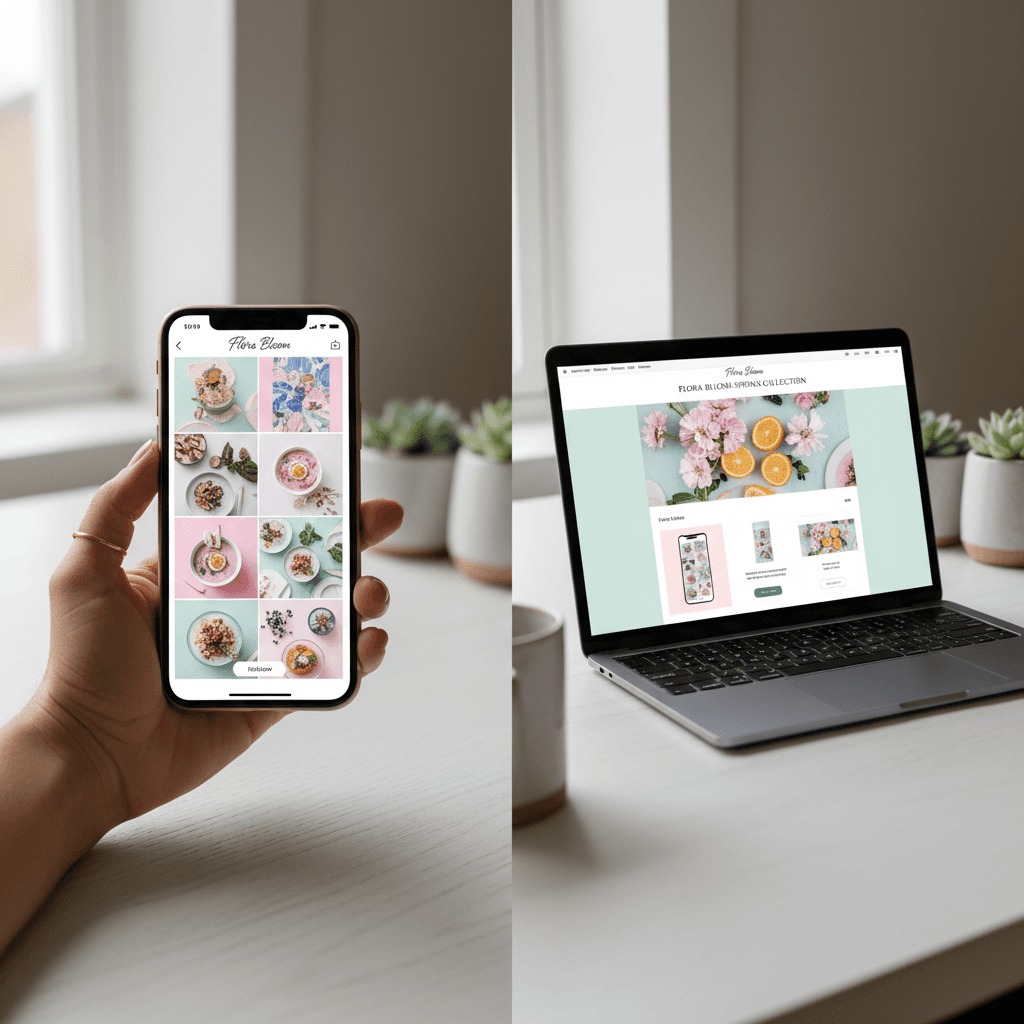
Email marketing and Instagram are the two most powerful channels for small ecommerce brands, and most businesses treat them as completely separate strategies. You have one team managing the Instagram account and another trying to figure out what to put in the weekly email. The content does not connect. The audiences do not connect. And you end up doing twice the work for half the impact.
The brands getting the most from both channels have figured out how to make email marketing and Instagram work together as a system — where each one feeds and amplifies the other. This guide explains how that works and how to set it up for your store.
Why Instagram and Email Marketing Are Stronger Together
Instagram and email serve different but complementary functions in a brand's marketing stack. Instagram is where you build awareness, attract new followers, and stay visible to people who have not yet committed to your brand. Email is where you deepen the relationship, drive repeat purchases, and convert warm interest into revenue.
The problem with treating them separately is that you leave the most valuable part of the funnel empty. Someone discovers you on Instagram, follows you, engages with a few posts — and then either sees a sale promotion in their feed or they do not. The algorithm decides how many of your followers see each post. On average, organic Instagram reach has been declining for years and now sits around 5 to 20 percent of your followers for most accounts.
Email flips this equation. When someone subscribes to your list, you have a direct line to their inbox. No algorithm decides who sees it. A store with 10,000 Instagram followers and a 15 percent average reach is reaching about 1,500 people per post. The same store with 2,000 email subscribers and a 35 percent open rate is reaching 700 people per send — people who opted in specifically to hear from you and are therefore far more likely to buy.
The combination works because Instagram grows the audience and email monetizes it. Followers who convert to email subscribers have a significantly higher lifetime value than followers who never make that transition.
How to Use Instagram to Grow Your Email List
The most underutilized email list-building channel for most Shopify brands is their existing Instagram following. Here is how to actually turn followers into subscribers:
Link in bio: Your Instagram bio link is the most reliable bridge between Instagram and email. Instead of linking directly to your Shopify store homepage, link to a landing page that offers something valuable in exchange for an email address. A 10% first-order discount, a style guide, a free recipe ebook — whatever is relevant to your audience. A dedicated landing page for this purpose consistently outperforms a generic homepage in conversion rate.
Story CTAs: Instagram Stories are the most direct way to drive traffic to any link. Use your Stories regularly to promote the email list with a specific reason to subscribe — "get our full product launch details before we post them publicly," "join the list for subscriber-only discounts," or "I'm sending this tutorial to my email list today, link in bio to get it." Concrete, exclusive reasons convert better than generic "subscribe to our newsletter" asks.
Launch announcements: When you are launching a new product or collection, tease it on Instagram but give the full details to your email list first. Post a partial reveal on Instagram with a caption that says something like "full details going to our email list in 24 hours — link in bio to be first." Exclusivity is one of the strongest opt-in motivators.
Giveaway entries: Structure giveaways so that email subscription is one of the entry methods, not just a follow or tag. "Follow us and subscribe to our email list" entries capture both channels at once. The followers you gain from a giveaway without email capture are low-quality; the email subscribers you gain are high-quality.
How to Use Your Email List to Amplify Your Instagram
The relationship between email and Instagram works in both directions. Your email list can actively grow and strengthen your Instagram presence:
Drive engagement on key posts: When you post something important — a new product launch, a campaign that matters to your brand, a post you want to see go wide — send an email to your list encouraging them to check it out, comment, and share. Early engagement is one of the signals Instagram's algorithm uses to determine reach. A loyal email list can give a new post the engagement boost it needs to get shown to more non-followers.
Share subscriber-only behind-the-scenes: Give your email subscribers access to content you do not post publicly — early product development photos, founder updates, content that did not make the Instagram grid. This creates a tiered relationship where email subscribers feel like insiders, which increases both list loyalty and the incentive for Instagram followers to subscribe.
Cross-promote your best email content: When you send a genuinely useful email — a skincare routine, a styling guide, a comparison of your products for different use cases — post about it on Instagram and direct followers to your email list to get it. Email content can fuel Instagram content and vice versa.
Using Instagram Content in Your Email Campaigns
Your Instagram feed is a library of branded visual content that most store owners are dramatically underusing in their email marketing. Every product photo, lifestyle shot, and behind-the-scenes video you have already created for Instagram is a potential email asset.
The most straightforward application is simple: repurpose your best-performing Instagram posts as email campaigns. A product photo that generated strong engagement on Instagram is likely to perform well in an email too — you already have validation from a real audience. Pull the image, write a slightly longer caption, and you have a campaign.
A more sophisticated approach is to let your Instagram content inform your entire email marketing calendar. If you are posting consistently to Instagram, you already have a content rhythm. New product shots, seasonal content, founder stories, customer features — all of this maps directly to email campaign types. An Instagram-to-email workflow, rather than treating email as a separate content creation task, dramatically reduces the time required to produce campaigns.
This is exactly the workflow that SendKite automates. SendKite connects to your Instagram account, analyzes your posts and visual identity, and generates on-brand email campaigns using your actual Instagram content as the creative foundation. Rather than creating new email content from scratch, you are repurposing the brand assets you have already invested in producing.
The Conversion Math: Instagram Followers vs Email Subscribers
Understanding the revenue difference between Instagram followers and email subscribers helps clarify why this combined strategy is so valuable.
A typical Instagram follower converts to a purchase at roughly 1 to 2 percent when you post a product. But only 15 to 20 percent of your followers see that post. So for 10,000 followers, you might reach 1,500 to 2,000 people and convert 15 to 40 of them into purchasers from that post.
A typical email subscriber converts at 2 to 4 percent per campaign, and 30 to 40 percent of your list opens the email. For 2,000 subscribers, you might reach 600 to 800 people and convert 12 to 32 into purchasers per send — comparable purchase numbers from a list that is five times smaller.
Now consider sending two emails per week. That is potentially 24 to 64 purchases per week from 2,000 email subscribers, versus 15 to 40 purchases per week from 10,000 Instagram followers posting daily. The email list punches far above its weight when used consistently.
The implication is that converting even a small percentage of your Instagram following to email subscribers has an outsized impact on revenue. An Instagram account with 5,000 followers where you convert 10 percent to email subscribers gives you 500 email subscribers — which, with consistent sending, can drive more revenue than the Instagram account itself.
Building the System
Tying email marketing and Instagram together as a coherent system comes down to three things: a consistent process for converting followers to subscribers, a content strategy that lets each channel feed the other, and a production workflow that makes creating email campaigns from Instagram content fast enough to do consistently.
Most brands get the first two right in theory and fail on the third. The content production bottleneck — turning Instagram posts into full email campaigns with copy, design, and strategy — is what kills email consistency for small teams. If it takes three hours to produce one email, you will send four campaigns a month if you are disciplined and two if you are busy.
Tools that compress that production time — whether that is a tight internal process, a freelancer on retainer, or AI email generation — are what separate brands that send consistently from brands that have good intentions about email and send irregularly. Consistency in email marketing, more than almost any other variable, predicts long-term revenue from the channel.