
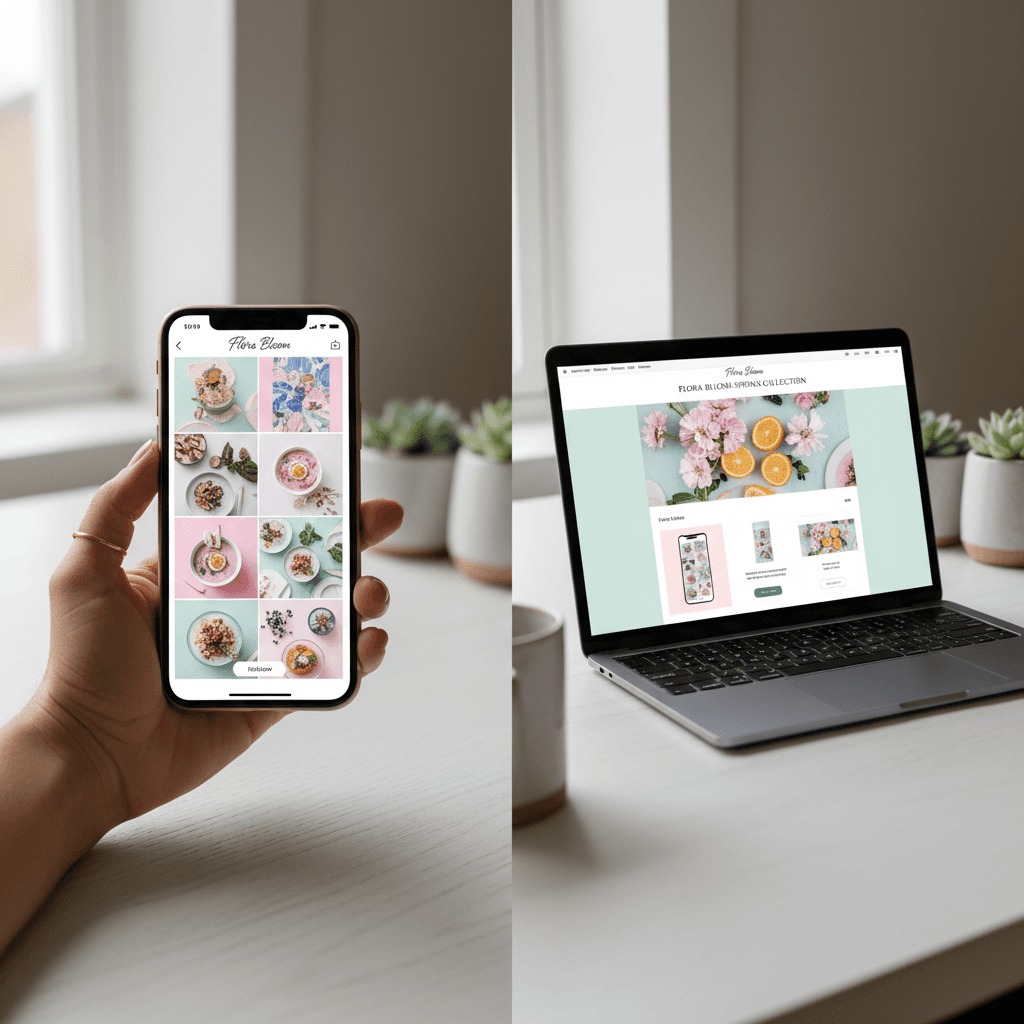
Email marketing for Instagram creators is the most underused revenue lever available to people who have already done the hard work of building an audience. If you have ten thousand followers, five thousand, even two thousand engaged people who care about what you make — you have everything you need to build an email list that earns more per subscriber than any brand deal you will ever land.
Most creators treat email as an afterthought or a "someday" project. This guide is for the ones who are ready to stop treating it that way. It covers why email matters more than most creators realize, what to send, how often to send it, and how to turn your Instagram content into email content without starting from scratch every week.
Why Instagram Creators Need Email (The Algorithm Dependency Problem)
Instagram reach is not yours to keep. You might have 50,000 followers and reach 3,000 of them organically on a good day. The platform decides how many people see your content, and that decision is made based on what serves Instagram — not what serves you.
This has real financial consequences. If your income depends on brand deals, and your brand deals depend on engagement, and your engagement depends on an algorithm you cannot control — you are building on rented land. Any creator who has watched their reach drop after a format change, a competitor's surge, or an unexplained algorithm shift knows exactly what this feels like.
Email is the opposite. When you send an email to 3,000 subscribers, 3,000 inboxes receive it. Open rates vary — good creator newsletters average 30 to 45 percent — but the delivery is guaranteed. No algorithm suppresses your content. No platform decides your post is "not recommended" this week.
There is also a monetization ceiling on Instagram that does not exist with email. Brand deals are capped by your reach metrics. Email monetization — through your own products, affiliate recommendations, paid communities, and digital products — scales with the trust you have built, which is not the same thing as follower count at all.
The Creator Email Advantage: Why Your Emails Will Outperform Brand Emails
Most marketing emails are written for a demographic segment. "Female, 25-34, interested in wellness." They are optimized, personalized in a technical sense (first name in the subject line), and still fundamentally impersonal.
Creator emails are different. Your subscribers are not there because they match a demographic profile. They are there because they specifically like you — your perspective, your voice, your content. That is a fundamentally different relationship, and it shows up in the numbers.
Creator newsletters routinely see open rates of 40 to 60 percent, compared to an ecommerce industry average of 15 to 20 percent. When you recommend a product in your newsletter, your conversion rate will typically be higher than a branded ad because the trust is different. You have earned it through consistent content. The brand paid for it.
This advantage only works if you maintain the personal voice. The worst thing a creator can do with email is start writing like a brand — formal, corporate, templated. Your subscribers signed up for you, not for a newsletter that reads like it was written by a committee.
Building Your First List: Where to Start
You do not need a sophisticated email platform to start. The priorities in order are: get an ESP, create one lead magnet or compelling reason to subscribe, and set up a simple welcome email. Everything else is optimization.
For creators just starting out, most ESPs offer free tiers that cover lists up to 500 to 1,000 subscribers. Klaviyo, Mailchimp, and ConvertKit are the most common starting points. Klaviyo is ideal if you also sell products — its Shopify integration and segmentation are best in class. ConvertKit (now Kit) has historically been popular with creators for its clean interface and creator-friendly features.
Your lead magnet does not need to be elaborate. For creators, the most effective offers are often the simplest: "get my full guide to [your niche]," "join my weekly newsletter," "subscribers get early access to my drops." Authenticity converts better than production value here. A PDF guide you wrote in a weekend will often outperform a polished five-module course that took three months.
If you want to go deeper on the mechanics of building your list from Instagram specifically, this guide covers six organic tactics that do not require paid ads.
What to Send: Content Ideas That Work for Creators
The question most creators get stuck on is: what do I actually send? The answer is almost always simpler than they expect, because they already have content — it is sitting in their Instagram grid and Stories archive.
Behind-the-scenes content: Your subscribers want access. They want to see what does not make it to the public feed — the process, the mess, the decisions, the failures. "Here is what actually happened during that shoot" is more interesting to your list than anything you posted publicly, because it rewards them for being subscribers.
Exclusive early access: If you are launching anything — a product, a collaboration, a course, a waitlist — your email list gets to know first. Every time. This is not just a nice gesture. It is a powerful mechanism for making people want to be on your list, because being on your list means something concrete.
Recommendations and roundups: What are you using, reading, watching, buying? Creator recommendations carry weight because they are personal. A roundup of five things you genuinely love — with a real explanation of why — is useful and monetizable (through affiliate links or your own products).
Extended takes: Instagram captions have a length limit and a context problem (people are scrolling). Email has neither. When you have more to say about something you posted — a fuller explanation, a longer story, a more nuanced opinion — email is where that depth lives.
Community moments: Share subscriber responses, questions, stories. Make your readers feel like they are part of something. This is the kind of content that makes people forward your newsletter to a friend, which is the most valuable growth mechanism you can have.
Frequency and Consistency: What Actually Works
The most common question and the one with the most anxiety attached to it: how often should I send?
The honest answer is that consistency matters more than frequency. A creator who sends reliably every two weeks builds a stronger reader habit than one who sends three times a week for a month and then disappears for six weeks. Pick a cadence you can maintain without burning out, and hold to it.
For most creators, weekly is the sweet spot. It is frequent enough to stay present in your subscribers' lives, and infrequent enough that you are not scrambling for content. If weekly feels like too much, start biweekly. If you are in a fast-moving niche (news, markets, sports), you might go more frequent.
What you want to avoid: disappearing for months and then sending a "hey I'm back" email. Subscribers forget who you are faster than you think. If life gets in the way, send a brief note explaining the gap. Silence is worse than a short "taking a break" message.
Day and time matter less than you have been told. Yes, there are aggregate studies suggesting Tuesday mornings perform well. But your audience has its own patterns, and the only way to find them is to test consistently and look at your own data. Most ESPs show you this breakdown in basic analytics.
Monetization Through Email: The Revenue Channels That Work
Email monetization for creators generally falls into four categories, each with different time horizons and margin profiles.
Affiliate revenue: The fastest path to monetization for small lists. Recommend products and services you genuinely use, include affiliate links, earn commission on sales. The key is relevance and authenticity — recommending things your audience would actually buy, not things that pay the highest commission. Your credibility is the asset; do not erode it for short-term commissions.
Digital products: Guides, templates, presets, courses, toolkits. High-margin, no inventory, infinitely scalable. Your email list is the primary distribution channel for your own products — it converts better than any social post because of the trust relationship.
Product drops: If you make physical products or have a Shopify store, your email list is your best launch channel. Early access for subscribers, limited quantities, the feeling of being in an inner circle — all of this creates a buying urgency that generic marketing cannot replicate.
Paid community or membership: A subset of your most engaged subscribers may want more access — a paid newsletter tier, a Patreon, a Discord with a monthly fee. Email is how you convert engaged free subscribers into paying members. The relationship is already there. The pitch is just the next step.
Turning Instagram Content Into Email Content
Most creators dramatically underestimate how much content they already have. If you post consistently on Instagram — three to five times a week, plus Stories — you have material for a weekly newsletter without writing a single new thing from scratch.
The workflow is simple: look at your best-performing post of the week. What was the caption? What story were you telling? Now write 200 to 400 more words on that same theme, add the image, give subscribers something they did not get in the public post (a follow-up thought, a resource, a personal aside), and you have a newsletter.
Your Stories are even more underused. The behind-the-scenes content, the polls, the Q&As — almost none of your subscribers saw all of your Stories this week. A "what happened in my Stories this week" recap email with two or three highlights is valuable, engaging, and takes 20 minutes to write.
If you want to accelerate this process significantly, SendKite automates the Instagram-to-email pipeline. It connects to your Instagram account, analyzes your recent posts, extracts your brand voice and visual style, and generates branded email campaigns ready to send through your Klaviyo account. What would take a few hours of writing and design takes minutes. The AI does the heavy lifting; you approve and refine.
How SendKite Helps Creators Specifically
Most email marketing tools are built for ecommerce brands or enterprise marketers. They assume you have a dedicated marketing team, weeks to set up automations, and an existing library of brand assets. Creators have none of those things.
SendKite is built around a different starting point: your Instagram content. The product connects directly to your Instagram account, uses your actual posts to understand your voice and aesthetic, and generates full email campaigns — headline, body copy in three variants, template design, subject line options — from that foundation.
For creators who also sell products through a Shopify store, the integration goes deeper: SendKite can identify which products you have been featuring on Instagram, match them to your Shopify catalog, and build product-forward campaigns automatically.
The emails send through your existing Klaviyo account, so your deliverability and subscriber data stay in one place. SendKite is the content generation layer on top of the sending infrastructure you may already have.
For a detailed look at how to grow the list that feeds this engine, read our guide to converting Instagram followers into email subscribers. When you are ready to put the content generation on autopilot, see a live demo of SendKite here.
Common Mistakes Creators Make With Email
Treating it like social media: Email is not Instagram. Shorter is not always better. The medium rewards depth and personal voice. Do not write three-sentence emails and expect the same connection you would build with a 400-word newsletter.
Only sending when they have something to sell: If your subscribers only hear from you when you want their money, your emails become unwelcome. Send value consistently — content, insights, entertainment — and your promotional emails will perform dramatically better because of the trust you have built.
Ignoring subject lines: The best email in the world does not matter if it does not get opened. Your subject line and preview text are the only things your subscribers see before deciding whether to open. Test different approaches: curiosity, specificity, personal tone. "What I learned from bombing my first launch" will outperform "This week's newsletter" on most lists.
Not segmenting as the list grows: When you have 500 subscribers, sending to everyone makes sense. When you have 5,000, the person who bought your course has different interests than the person who just signed up for your free guide. Basic segmentation — by purchase history, by engagement level, by interest signal — dramatically improves results without requiring a lot of additional work.
Waiting until the list is "big enough": This is the most expensive mistake. Start now. Your 200-subscriber list is good practice, builds sending reputation, and teaches you what your audience responds to. By the time you have 2,000 subscribers, you will have two years of data and habit instead of starting from scratch at a larger scale.